Tolerances in Translation: Tuning Formwork Practice to Imported Turkish Mix Behavior
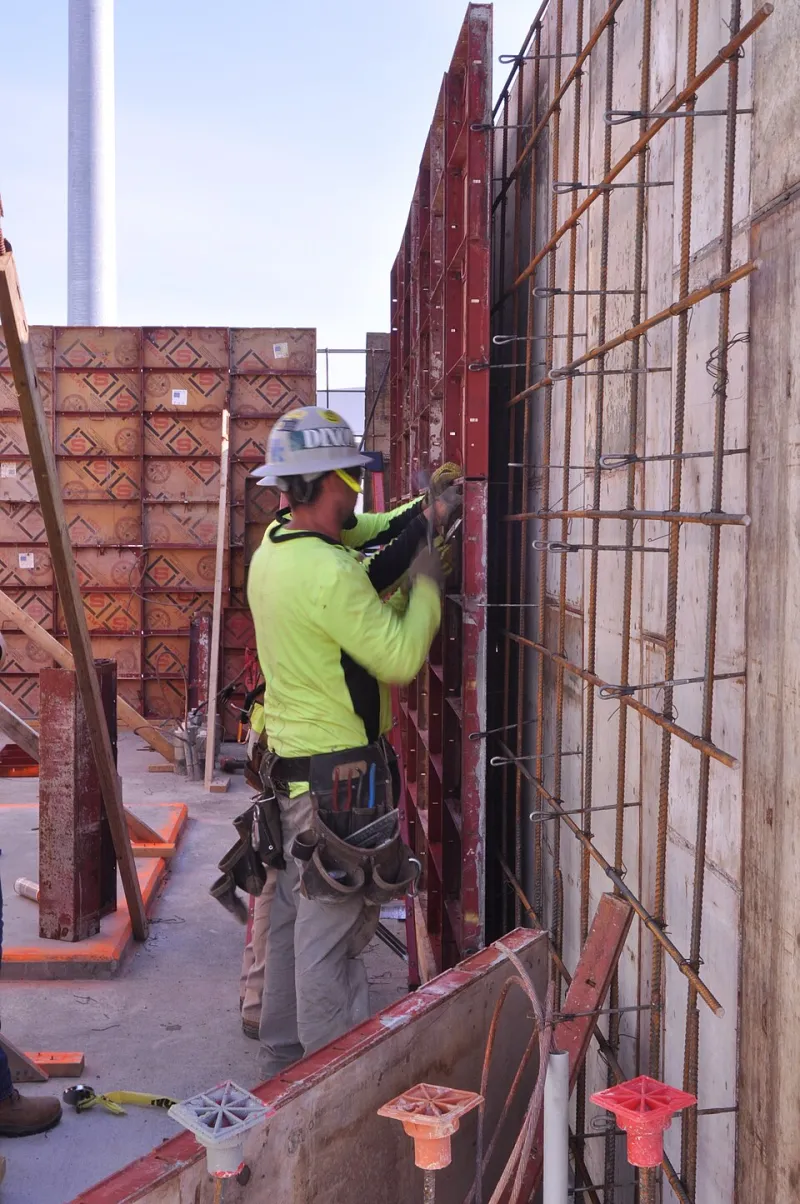
Photo: PEO ACWA, CC BY 2.0, via Wikimedia Commons
There is a version of this conversation that goes badly, and it usually starts with a superintendent asking whether the tolerances are different for the imported mix. They are not. ACI 117 sets formwork tolerances and ACI 318 sets cover requirements, and neither document contains a clause that relaxes when the concrete crosses an ocean.
What does change is margin. A crew that has spent years placing a familiar domestic mix has an intuitive sense of how much slop the process absorbs. Introduce a mix with different aggregate angularity, a different admixture package, and a longer and less predictable handling sequence, and that intuition is quietly wrong — not catastrophically, but enough to erode cover, open a form joint, or leave a cold joint where none was planned. The correct response is deliberate adjustment at a handful of specific points.
Where the difference actually comes from
Whether the material arrives as precast, as packaged dry constituents, or as a mix batched at a partner plant to an Istanbul-approved design, the variables trace to three sources: aggregate grading and particle shape; the admixture package, especially superplasticizer chemistry and retarder dosage; and variability introduced by handling, storage, and time between batching and placement. None of these is exotic. All of them interact with formwork in ways that domestic crews do not automatically expect.
Add margin where the tolerance is one-sided
Concrete cover is the clearest case. Because the cover tolerance in ACI 318 is effectively one-directional, any variability in form alignment, spacer placement, or form deflection is spent directly against durability rather than split between over and under. On a first placement of an unfamiliar mix, we recommend tightening form alignment and reinforcing steel positioning well inside the permitted envelope, verifying spacer density, and treating form deflection under hydrostatic pressure as a design input rather than a site surprise. Where an architectural finish is specified, the same logic applies to verticality and to the F-number targets: hold a margin, and document that you are holding it, so nobody mistakes the practice for the requirement.
Release agents and form-face chemistry
Low water-to-binder mixes with high-range water reducers can be noticeably tackier at the form face, and the result is edge tearing and a bughole pattern that surprises a crew accustomed to a wetter, more workable domestic mix. Two practical steps: run a mock-up panel with the actual form material and two candidate release agents, and confirm with the supplier whether the retarder dosage is expected to extend the period during which the surface remains sensitive to vibration and finishing. Over-application of release agent is not a safe default; it produces its own surface defects and can interfere with subsequent coatings.
Pour rate and lift height
Formwork pressure is governed by the placement rate, the concrete temperature, the mix's setting behavior, and the form design. A mix with extended set can pressure a form for longer than a crew expects. Resist the temptation to speed up early lifts in order to stay ahead of a set that has been deliberately retarded. Agree the maximum rate and lift height in the pre-placement plan, reference the form design pressure, and watch the first lift rather than the schedule.
Strip on strength, not on the clock
Strip times carried over from a domestic mix are a guess. Use maturity methods per ASTM C1074 or field-cured cylinders to establish the strip criterion, and write the criterion into the plan rather than the elapsed hours. Cold weather amplifies the error, since a retarded mix in low temperatures can be well short of the assumed strength at the assumed time. Where the supplier's own test data is available, compare it with the field-cured results before the first strip and adjust the schedule to the local reality.
Field cues worth watching on the first placement
- Bleed water appearing later and in less volume than the crew anticipates
- Rapid slump loss between the thirty- and sixty-minute checks
- Edge tearing at the form face during vibration
- Vibration response that feels stiff well before the specified time window closes
- Visible form deflection or joint separation during the second lift
- Surface set that behaves differently at the top of the pour than at the bottom
None of these signals requires panic. Each one requires a note, a photograph, and a comparison against a control pour using domestic material under similar conditions. That control pour is the most useful single investment a contractor can make before committing a full floor to an unfamiliar mix.
The overreaction risk
Some teams respond to a first imported placement by tightening everything, which produces cost without benefit and teaches the crew nothing. The disciplined approach is narrower: hold margin where tolerances are one-sided, validate release agent and strip time empirically, control the pour rate against the form design, and document the baseline so the second placement is routine. Formwork does not care where the concrete was born. It cares about pressure, chemistry, timing, and the discipline of the crew standing behind it.