Rethinking the Math: How Bulk Turkish Concrete Orders Beat Domestic Rush Pricing on Total Cost
Conventional procurement wisdom in the American construction industry holds that international sourcing is a premium-tier decision—something reserved for specialty materials that simply cannot be obtained domestically. For commodity inputs like concrete products, the assumption is that local suppliers will always win on price once freight and customs are factored in. That assumption, it turns out, is built on an incomplete cost model.
When procurement managers begin accounting for the full range of costs associated with fragmented domestic ordering—particularly under the timeline pressures that characterize most active job sites—the economics of bulk Turkish sourcing shift considerably. The comparison is not as straightforward as comparing a per-unit price from a domestic supplier to a landed cost from Istanbul. It requires a more disciplined analysis of how each procurement pathway actually performs across the full duration of a project.
The Hidden Architecture of Domestic Rush Costs
Domestic concrete procurement appears simple on its face: you call a local supplier, place an order, and material arrives within hours or days. The per-unit price is visible and familiar. What is less visible is the cost structure that accumulates around fragmented, reactive ordering.
When project timelines compress—as they reliably do—contractors who depend on domestic supply networks face a cascade of premium charges. Rush delivery surcharges are standard practice across the American ready-mix industry, often adding 15 to 25 percent above base pricing for orders that fall outside standard scheduling windows. When multiple rush orders are placed across different phases of a project, these premiums compound. A contractor managing a large commercial project who has placed six to eight domestic rush orders over a construction season may have paid a cumulative premium that rivals the freight cost on a single well-planned bulk shipment from overseas.
Beyond surcharges, fragmented domestic procurement generates substantial logistical overhead. Each order requires coordination, documentation, receiving inspection, and quality verification. When these administrative costs are aggregated across dozens of individual orders, the labor burden becomes significant. Procurement staff, project managers, and site supervisors absorb hours of coordination work that rarely appears in a simple cost-per-yard comparison.
How Ocean Freight Economics Actually Work
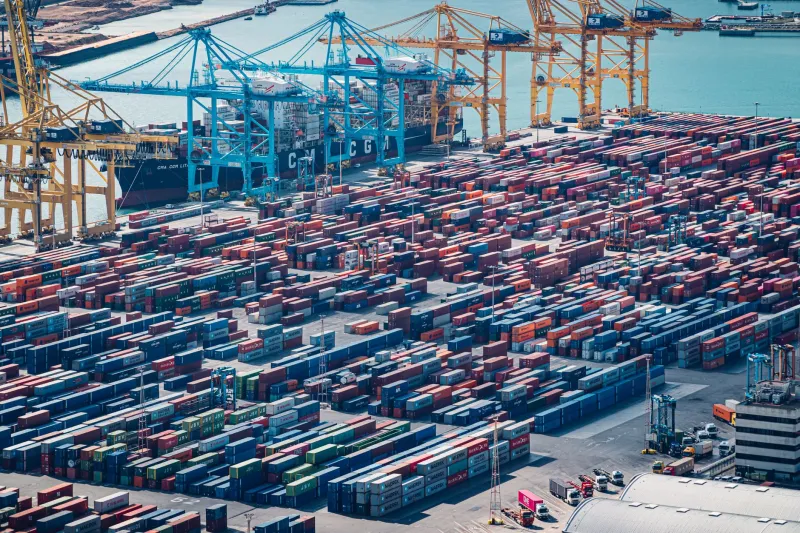
A common misconception about international shipping is that it scales linearly—that a larger order simply costs proportionally more to transport. In practice, ocean freight economics operate on a fundamentally different curve. The fixed costs associated with container booking, port handling, customs clearance, and documentation are largely independent of order volume. Whether a shipment fills one container or twenty, many of the per-shipment fixed costs remain constant.
This creates a powerful economy of scale for bulk orders. When a contractor consolidates what would have been multiple domestic procurement events into a single large Turkish order, those fixed international logistics costs are amortized across a much larger volume of material. The per-unit freight cost drops substantially as order size increases, often reaching a level that competes directly with domestic delivered pricing—before accounting for the base price advantages that Istanbul-based producers can offer through their manufacturing scale and raw material sourcing.
Turkish concrete producers who serve export markets operate at production scales that allow them to offer pricing structures that domestic regional suppliers simply cannot match. The clinker and aggregate sourcing advantages available to major Istanbul-based manufacturers, combined with the operational efficiency of high-volume production facilities, create a cost basis that translates into competitive landed pricing even after ocean freight is incorporated.
The Minimum Order Threshold Calculation
For many contractors, the practical question is whether their project volume is sufficient to reach the order thresholds where bulk international economics become favorable. The answer varies by project type, but the threshold is lower than most procurement managers initially assume.
For projects requiring 500 cubic meters or more of a given concrete specification—a threshold that mid-scale commercial, infrastructure, or multi-family residential projects routinely exceed—the bulk international model begins to demonstrate meaningful cost advantages. At 1,000 cubic meters and above, the economics become difficult to ignore. At these volumes, the combination of per-unit material savings, freight amortization, and elimination of domestic rush premiums can produce total procurement savings in the range of 12 to 22 percent compared to reactive domestic ordering under typical timeline conditions.
The key enabling factor is planning horizon. Bulk international procurement requires contractors to specify their concrete requirements earlier in the project lifecycle than domestic reactive ordering demands. This is not a disadvantage—it is a discipline that tends to produce better project outcomes across multiple dimensions, including schedule management and specification consistency.
Customs, Compliance, and the Logistics Learning Curve
Contractors who have not previously sourced materials internationally sometimes cite customs and import compliance as barriers that offset the cost advantages. This concern is legitimate but manageable. The American import framework for construction materials, while not trivial to navigate, is well-established for suppliers who regularly export to U.S. markets. Istanbul-based producers with active American client relationships maintain the documentation infrastructure—material certifications, country-of-origin declarations, compliance records—that customs clearance requires.
The logistics learning curve is real but front-loaded. Contractors who complete their first international concrete procurement engagement report that subsequent orders are significantly smoother, as the administrative processes become familiar and relationships with freight forwarders and customs brokers are established. The overhead associated with international procurement is largely a one-time investment rather than a recurring cost.
Reframing the Comparison
The productive frame for evaluating international versus domestic concrete procurement is not a simple price-per-unit comparison at a single point in time. It is a total cost analysis that accounts for the full procurement lifecycle: base material cost, delivery premiums, logistics overhead, administrative burden, and the cost of quality inconsistency that fragmented domestic ordering can introduce.
When American contractors and procurement managers apply this framework rigorously, the results consistently challenge the assumption that domestic sourcing is the default economical choice. The volume paradox—that larger orders from Turkey can cost less than smaller domestic rush shipments—is not a marketing claim. It is an outcome that emerges from a disciplined examination of how construction procurement costs actually accumulate on active job sites.
For contractors willing to engage that analysis honestly, Istanbul represents not an exotic alternative but a pragmatic procurement strategy built on verifiable cost logic.