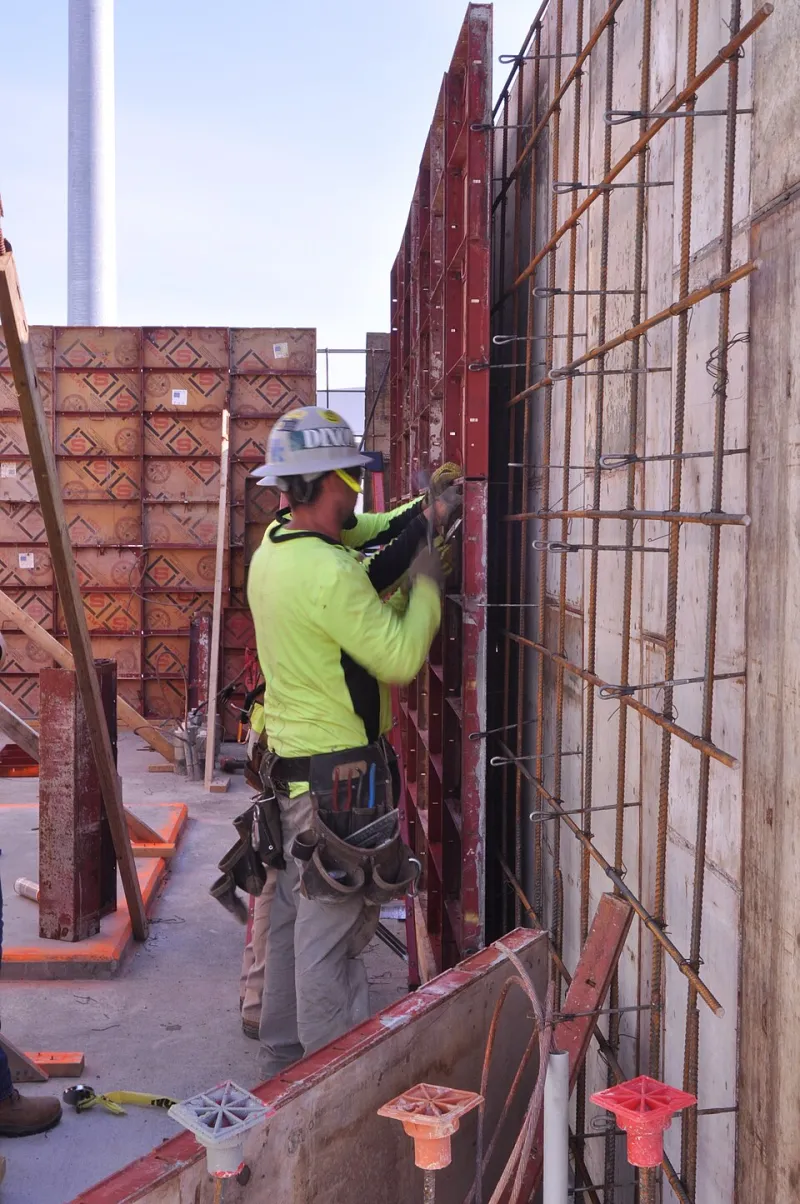
The Forty-Degree Threshold: Field Discipline for Turkish Concrete in U.S. Winter Pours
Photo: Leonhard Lenz, CC0, via Wikimedia Commons
Cold-weather concreting is often treated as a heating problem. In practice, it is a timing problem. Ambient temperature, mix temperature, set behavior, finishing windows, and curing protection all move together. When the concrete is sourced from Istanbul and placed on a U.S. site in January, those variables deserve a more deliberate field plan than a familiar domestic mix might require.
At Istanbul Beton, we see the issue from both sides of the ocean. Turkish batch plants can produce highly consistent concrete, but a mix designed for one climate and shipping route does not automatically behave like the local ready-mix a U.S. crew places every week. The forty-degree threshold is a useful trigger point for resetting field assumptions before the first truck arrives.
Cold Weather Is a Plan, Not a Heater
ACI 306.1 defines cold-weather concreting conditions and sets expectations for temperature protection, monitoring, and curing. Project specifications may be stricter. The practical lesson is that cold-weather protection must be designed before the pour, not improvised after the weather turns.
For an imported Turkish mix, the cold-weather plan should begin with data from the supplier: expected set time at the anticipated discharge temperature, recommended accelerator or retarder package, curing requirements, and any restrictions on field water addition. Those items belong in the pre-pour meeting, not in a phone call to the batch plant after the first slump test looks wrong.
Why Turkish Mixes Can Feel Different in the Cold
Turkish concrete producers work with a range of cement types, supplementary cementitious materials, and locally available aggregates. Some mixes are designed for hot summers and long transit times. Others include limestone filler, fly ash, or slag at proportions that influence early strength gain and finishing behavior. None of these choices is inherently problematic, but each changes how the mix responds when the air is cold and the forms are chilled.
A mix that performs well at 70°F may set more slowly at 45°F, or it may stiffen earlier if the cement is finer and the admixture package is not tuned for the placement temperature. The field crew should not guess. Ask the Istanbul batch plant for set-time curves or trial data at the expected winter temperature range. If those data are unavailable, request a trial batch or a mock pour before the structural pour.
Admixture Decisions Belong at the Batch Plant
Cold weather tempts field teams to add accelerator at the chute. That is usually the wrong place to solve the problem. Admixture dosage should be coordinated with the Istanbul supplier and reflected in the approved mix design. Field additions can create unpredictable interactions, especially when a retarder was included for transit and an accelerator is added later.
Chloride-based accelerators are generally unacceptable for reinforced concrete. Non-chloride accelerators may be appropriate, but the supplier should confirm compatibility with the cementitious system and any air-entraining or water-reducing admixtures already in the mix. The goal is a coherent cold-weather package, not a collection of field remedies.
Temperature Control From Discharge to Finish
ACI 306.1 requires minimum concrete temperatures during placement and protection. Common specifications call for concrete to be maintained at or above 50°F for normal-weight sections, with higher requirements for thin sections or severe exposure. The exact limit belongs in the project specification, and the field team should verify it before the pour.
Temperature control starts with the truck. Measure concrete temperature at discharge, not just ambient air. Use insulated forms, heated enclosures, windbreaks, and insulating blankets as specified. Avoid direct high-temperature heat that can dry the surface or create thermal gradients. For thick sections, monitor internal temperature and differentials with thermocouples. For thin sections, focus on preventing freezing and rapid heat loss.
Curing Protection and the First 24 Hours
The first day after placement is decisive. Cold concrete gains strength slowly, and a surface that freezes before it has developed adequate strength can be permanently damaged. Protective covers should be in place before the pour, not sourced after the weather report changes.
Use maturity meters or thermocouples where the specification allows, and supplement them with field-cured cylinders stored under the same protection as the structure. Do not rely on a single cylinder result to justify removing protection early. The structure, not the test specimen, is what must be protected.
The Overnight Forecast Loop
Winter weather changes faster than a batch plant schedule. A useful protocol assigns a weather trigger, a decision authority, and a cutoff time. For example, the field superintendent and the Istanbul Beton coordinator may agree to review the forecast at 2 p.m. local time on the day before the pour. If the predicted low falls below the agreed threshold, the pour is either protected with a revised plan or postponed.
That conversation should include the batch plant time zone, truck loading sequence, admixture adjustments, and the availability of blankets, heaters, and testing personnel. Document the decision in the daily report. A clear record protects both the contractor and the supplier if the weather turns again.
A Short Winter Field Checklist
- Confirm the ACI 306.1 and project-specification temperature limits before the pour.
- Obtain supplier set-time data for the expected winter temperature range.
- Verify the approved cold-weather admixture package and prohibit unapproved field additions.
- Measure concrete temperature at discharge and during protection.
- Stage insulation, enclosures, heaters, and thermocouples before the pour.
- Assign a weather decision authority and a forecast review time.
- Record every weather-related schedule decision in the daily log.
Cold weather does not have to make imported concrete unpredictable. It does require that the mix, the batch plant, and the field crew work from the same plan. The forty-degree threshold is not a warning to cancel work. It is a prompt to slow down, verify assumptions, and place the concrete on terms the material can meet.